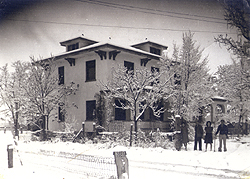
Bottger Mansion
Albuquerque Citizen
Dec 2, 1908
MRS SHERIDAN WAS BORN AT OLD FT. UNION
A Letter From Her Sister Settles Question Which Has Been Long Discussed.
Albuquerque, N. M., Dec. 2, 1908
Editor Albuquerque Citizen:
Many have been the yarns reeled off regarding the birthplace of the lady whose name appears at the head of this communication. The large and old adobe structure situated immediately west of the Bernallllo county court house in the ancient town of
Albuquerque, has been pointed out to thousands of tourists and others as the place where Mrs. Sheridan was born. This large building was at one time the residence of Don Manuel Armijo the last of the Mexican governors of the province of New Mexico. He sold It to the late Don Cristobal Armijo, who lived in it for many years and had it leased to the United States for officers quarters; and in it lived Major D. H. Rucker, U. S. army, in 1862. A short time before his death, Don Cristobal sold the property to Mrs. Julia Bottger of New York City. For several years before his death the house was occupied by the much lamented Henry V. Harris, who at the time of his demise was probate clerk and recorder of Bernalillo county. The family after his death moved to the city. The present occupants are Charles Bottger and Frank Yott ad their respective families.
I had had a faint remembrance that some one told me soon after my arrival in New Mexico in 1868 that Mrs. Sheridan was not born in Albuquerque, but where, I did not remember. So about three months ago I wrote a letter of Inquiry for the fact in the case to Brigadier General Daniel H. Rucker, U. S. army retired. Owing to the infirmness consequent to his age (96 years), I failed in getting replies to my queries. Today I received the following letter from Washington, which explains Itself:
"1024 Jefferson Place.
My Dear Mr. Whiting:
I received your letter of November twenty-second.
My sister, Mrs. Sheridan was born at Fort Union and my sister Sarah Rucker was born at Albuquerque. As they are very near the same, I suppose that is the reason for the mistake.
November 26th. Sincerely yours.
LOUISA RUCKER."
When Albuquerque was evacuated and abandoned by the United States forces on the approach of the Confederate Texans under Sibley in 1862, Major Rucker's family, was taken to Fort Union, Mora county, New Mexico where the future wife of the great cavalryman was born.
Fort Union was abandoned many years ago.
Very truly yours
R. H. WHITING
Note: Mrs Sheridan (1856–1938) had maiden name, Irene Rucker, and was the 2nd of Major Rucker's five children with his second wife, Irene Curtis (1819–1902). Louisa Rucker (1843-1924) was Irene's half sister and the daughter of Rucker and his first wife, Flora McDonald Coodey (1824-1845), who had distinguished Cherokee ancestry. Her two children were Louisa and Ross (1841-1858).
Turmoil in New Mexico 1846-1868 (1952)
by Willian A. Kelleher, Rydal Press, Santa Fe, NM
Chapter - General Kearny comes to Santa Fe, page 129, entry 61:
“
While enroute to New Mexico, cholera broke out among Sumner's troops, killing Surgeon Kennedy and thirty-four soldiers. Daniel Henry Rucker, born in Belleville, N.J., April 28, 1812, spent his boyhood in Grasse Isle, Mich., enlisted in the U.S. Army on Oct. 13, 1837, died in Washington D.C., in 1910. Rucker served as an officer in New Mexico for some years in the 50's, living part of the time in Albuquerque in a house owned and at one time occupied by Governor Manuel Armijo, later owned by his nephew, Juan Cristobal Armijo. The Armijo residence, then immediately west of the Bernalillo County Courthouse of 1886, was razed in 1912 and a two story house was built on the site for Charles Bottger. Anne Rucker, daughter of Major Rucker, born in the Armijo house in Albuquerque, was married to General Phil H. Sheridan in Chicago, on June 3, 1873.
excerpt from..
Albuquerque Tribune, Sept 10, 1964
Off the Beaten Path
By Howard Bryan
RETURNING TO New Mexico over the Santa Fe Trail, Mrs. Lane proceeded south to Ft. Stanton, where her husvand had been transferred during her absence.
She paused in Albuquerque on this trip, where she was the guest of Col. and Mrs. Ruff. Recalling the visit, she wrote:
"He (Col. Ruff) and Maj (Daniel H.) Rucker and families occupied a large adobe building, each had a part of it, entirely independent of the other. At that time, Irene Rucker was a little child playing about in her blue check aprons, little dreaming she was destined to be the wife of the gallant Gen. Phil Sheridan."
The adobe home which Mrs. Lane referred to in her book was the old Juan Cristobal Armijo residence, which was torn down in 1912 to make way for a two-story Charles Boettger home, which still stands at 110 San Felipe NW, and which is occupied by Mrs. Julia B. Gallegos.
The Albuquerque Journal, Jan. 21, 1954
Off the Beaten Path
By Howard Bryan
There was, at one time, a toll bridge across the Rio Grande in Albuquerque.
This early bridge was about where the Old Town bridge is today. It cost 10 cents to cross it, and it was used principally by residents of Old Albuquerque who had fields or cattle on the west side of the river.
The toll bridge was built and operated by
Thomas Post, an early settler who came to Albuquerque over the Santa Fe Trail. Mr. Post has been dead more than a half century, but stories of some of his activities have been handed down to hls granddaughter, Mrs. Julia B. Gallegos, who lives in Old Albuquerque at 2015½ Central NW.
Mrs. Gallegos said she does not know exactly when her grandfather came to Albuquerque, but that it was long before the railroad arrived here, which was in 1880.
Mr. Post, who had come to the territory from Kansas City, operated his toll bridge for several years. It was later washed away by flood waters.
"I have heard that my grandfather built a two-story merchandise store on his bridge," Mrs. Gallegos said. "I don't know how that was possible, but I have heard from several sources that it was true."
After hls bridge venture, Post drove stage coaches in this area for a while. Then he went into the hotel business.
For many years, before there was a "new" Albuquerque, Post operated the old Post Exchange Hotel in what is now Old Town. It was the only hotel in Albuquerque during those days.
ThIs old hotel, or at least a major portion of it still stands in Old Town although it is almost hldden by buildings of more recent origin. It is located just west of San Felipe NW bctween Central Ave. and the Old Town Plaza.
The Post Exchange Hotel, In later years, was called the San Felipe Hotel. The old adobe structure, with a portal in front, recently was remodeled to house art galleries and gift shops. It should not be confused, incidentally, with another San Felipe Hotel which stood on the site of the present Elks Lodge in new Albuquerque.
Mrs. Gallegos tells an interesting story of lost gold in Old Town that has been handed down from her grandparents.
According to this story, Post was threatened by some Indians in the early days who wanted his money. It was while he was running the hotel.
Mr. and Mrs. Post (he married a local girl) had adopted and reared several Navajo children, and one of them, a boy of about 20 at the time, was told to take the family money and valuables and bury them near the hotel for safe keeplng.
The boy was given a small fortune in square, gold coins as well as other gold ornaments, which he placed In a vase and burled. Soon afterward some Indians attacked the hotel and killed and scalped the Navajo boy when he refused to tell them where he had hidden the family gold.
Unfortunately, the Posts didn't know where the gold was buried, either, and It is said that this fortune still lies buried somewhere near the old Town plaza.
Later on, Post bought a large 40-room adobe house sloutheast of the plaza from Don Francisco Armijo. This house, a long rambling affair with hand-carved-pillars in front, served as headquarters for Gen. Phil Sheridan when he was stationed in Albuquerque in the 1870's. Gen. Sheridan' daughter was born in this old
home.
When Post bought the home, there were barracks in the rear which had been used by soldiers during the Civil War. Not a trace of the home or the barracks remain today.
The Posts had one daughter, Miquella, who was married to Charles Bottger, scion of a wealthy New York family wbo came to Albuquerque in about 1893 for his health. Mr. and Mrs. Bottger, now deceased, were the
parents of Mrs. Gallegos.
The Bottgers, who had inherited the old adobe home wlth the wood pillars, tore it down in 1900 and built a substantial two-story home on the site. It is in this yellow and blue home, just west and a little north of the San Felipe School that Mrs. Gallegos lives in today.
The Bottger home was quite a show place in 1900. It was constructed of cement blocks. and much of the interior woodwork is of handcarved oak and mahogany. The various rooms and the porch were connected with speaking tubes, and there were dumbwaiters between the floors.
Mrs. Gallegos has filled her home with many interesting old antiques, including old silver pieces that belonged to the Posts. She even has a perfume bottle, more than 100 years old that belonged to her grandmother Post.
Before his death in 1912. Mr. Bottger spent many hours in Old Town looking for his father-in-law's lost gold, Mrs. Gallegos recalls.
Mrs. Gallegos, who was born in the old hotel about 100 yards northwest of her present home, long has been prominent in local civic affairs. Her husband, George Gallegos, is a well-known Albuquerque artist.
The Albuquerque Journal, Business Outlook
Week of Monday April 20, 1987
Old Town Mansion Getting New Life as Gallery
By Rhonda Hillbery
An Old Town landmark, called "The Pride of Old Town" when it was built in 1911, will be returned to its original luster this spring when Bottger Mansion Gallery opens its doors.
In a joint venture, the McMillan's of Santa Fe furniture company and a group of investors will pair Soutnwestern furniture and fine art in the 2 1/2 story building that is registered on the National Register of Historic Places.
"We're going to furnish it like a real house," said Gary Beals, coowner of the McMillan's. "A bedroom will look like a bedroom; the parlor will look like a parlor."
McMillan's furniture will be accented by rugs, paintings, and accessories.
The work of Southwestern painters, sculptors and lithographers will be featured throughout the house with the red tiled roof at 110 San Felipe NW. The gallery will open May 1.
The investors hope the historic status of the Bottger Mansion will make the location as strong a draw as the merchandise. They will spend $100,000 on the renovation, and have signed a 15-year lease with the owner, the Lena Garcia estate.
Edward Buxton Christy, Albuquerque's most prominant architect of the period, designed the building for a wealthy entrepreneur from New Jersey, who married into the Old Town family.
It's dinstinctive white with turquoise trim will become white with gray, but no exterior changes are planned for the American Foursquare-style building's large windows, broad eaves and veranda.
Historians say the mansion was built with "every conceivable luxury" of the day - the first gas lights in Albuquerque, chandeliers, dumbwaiters and speaking tubes between rooms.
Over the past 20 years, the building's interior has taken a beating. It was used as a rental and then it was vacant for years, and many of the built-in cabinets and stained glass windows were stolen. Renovators had to stain the pine woodwork mahogany to cover its scars.
Much of its original glory remains, however. According to a description written for the national register application, the home's crowning glory is its elaborate pressed-metal ceilings featuring swags, medallions and wreaths set in geometric patterns.
The renovation includes stripping the hardwood floors and installing marble floors in the veranda and enclosed back porch.
The art gallery will be owned by a corporation of unnamed investors. It will specialize in Southwestern impressionism, realism, and contemporary art.
Gallery director Claudia Anison said the ideal came together through mutual interest. "Market research studies show furniture and art sell better together than apart. Because this building was available, we though it was a beautiful setting for the concept."
Art will include water colors by Steve Hanks, stained glass by Janet Lilnden, bronze sculpture by Bill Moyers, lithigraphs by Amado Pena and oils by Julian Robles and Betty Sabo.
McMillan's, founded by Dennis McMillan in the 1970's, has earned national notice for its traditional New Mexico furniture, now sold throughout the country.
It markets its furniture as the other Early American style, pointing out that New England isn't the only region with a distinctive indigenous style.
As Beals describes it, local cabinetmakers infused Spanish styles with Pueblo Indian design to build a distinctive style. Later, as the Anglos arrived in the 1800's, influences from the East Coast were also incorporated.
The rough-hewn, straight-line look of the Southwestern style stems from the simple hand tools used on what is typically soft pine wood.
McMillan design lines include New Territorial, traditional Spanish-New Mexican, and contemporary Territorial, all hand-finished.